Do Sex AI Companions Remember Previous Conversations?
Partly, and the word partly is the useful part. Crushon describes its Sex AI companions as adapting to your personality and remembering your preferences, and the product keeps a dedicated Memories area beside the character list because continuity is something you maintain rather than something that simply happens. What tends to survive a week's gap is a preference or a running plot thread; what slips away is the incidental detail nobody ever restated.

Key takeaways
- The platform's own description covers the mechanics: characters recall previous interactions, express emotion and adapt over time.
- Continuity holds best inside one thread. Restating a key fact costs one sentence; repairing a dropped plot later costs a whole scene.
- Favourites and Memories do different jobs — one keeps a character, the other keeps a conversation — and neither substitutes for the other.
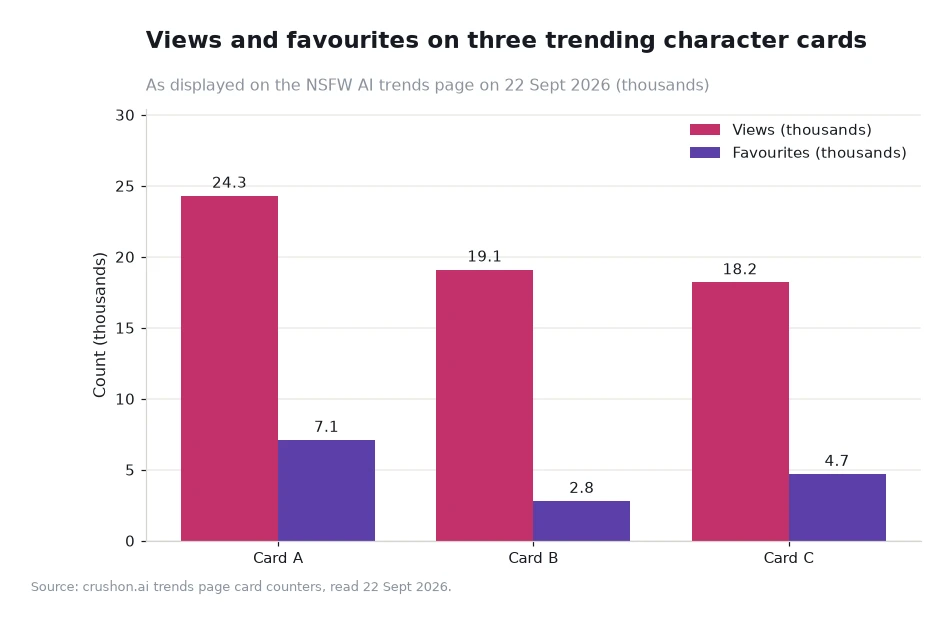
- Repeat reading is visible in the counters: 7.1K favourites against 24.3M views on the leading card is about 292 favourites per million views.
What recall actually covers
Two kinds of memory matter in day-to-day use. Preference memory is how a character's tone settles around yours: the register it uses, the pace it keeps, the kind of detail it picks up on. Scene memory is the state of the thread itself — what has been established, what was promised, where the story currently sits. The platform describes both loosely when it says characters remember preferences and adapt over time, and that description is accurate enough to plan around.
It is worth being precise about what a stored memory is. Nothing in a chat platform resembles a person recollecting an event. Characters are AI-generated text profiles, and the compliance statement on the site states plainly that its content depicts no real person and that the platform does not produce images or video of its own. Memory is a property of the system that builds replies, plus whatever the platform chooses to keep, not a record of anyone's experience.
That distinction changes the practical advice. If memory belongs to a thread and a profile rather than to a witness, then the way to make a story hold together is to give the system something to work with: specific details, consistent naming, and a small number of active threads rather than a dozen half-open ones.
Where continuity breaks
Every conversation has a horizon. A thread that spans weeks compresses as it grows: the earliest part of it carries less weight than the most recent exchanges, which is why an early detail can quietly fall out of view while the last ten minutes stay sharp. Long arcs are still possible, but they are more reliable when they are built as a sequence of scenes than as one unbroken marathon.
Switching characters in the middle of an arc is the most common cause of a dropped thread. The second most common is returning after a break with no re-entry point, so the first few messages are spent re-establishing facts rather than continuing the story. The third is drift: small contradictions accumulate until the thread stops making sense, and at that point readers usually abandon it rather than repair it.
| What you want to keep | How well it holds | How to protect it |
|---|---|---|
| A stated preference | Well — it shapes replies rather than sitting as a fact | Say it once, early, in plain language |
| The current plot situation | Well, inside one continuing thread | Keep the thread open instead of restarting it |
| A name, job or backstory line | Moderately, if it keeps being relevant | Repeat it when it matters, not every message |
| An offhand remark from weeks ago | Poorly, unless something depends on it | Restate it as a reminder when the scene needs it |
| A second character's thread | Well, but only within its own conversation | Treat each thread as separate; do not assume crossover |
Worked example: what favourites imply about return sessions
The card counters on 22 Sept 2026 give the arithmetic a starting point. The leading card showed 7,100 favourites against 24,300,000 views. Divide the smaller number by the larger: 7,100 ÷ 24,300,000 = 0.000292, or about 0.029%. Expressed per million views that is 292 favourites. Do the same for the second card: 2,800 ÷ 19,100,000 = 0.000147, roughly 147 favourites per million views, about half the rate of the leader.
Now make one illustrative assumption and see what follows. Suppose each favourite stands for six return sessions of twelve minutes. The leader's favourites would then correspond to 7,100 × 6 = 42,600 sessions, and 42,600 × 12 = 511,200 minutes of conversation, or 8,520 hours. That figure is a scale check rather than a measurement — it is not platform data, and the assumption is invented — but it shows why memory sits at the centre of the product: a returning reader is repeating a conversation, and a conversation that does not accumulate is a conversation that has to be rebuilt.
Starting a thread you intend to keep
The page that explains the product's own framing is https://crushon.ai/ai-sex-chat, and reading it before you start is faster than discovering the mechanics by trial. Once a thread is running, keep the character list and the thread itself apart in your own head: browsing new profiles is what the character search page is for, while continued stories belong with the thread you already began. A shortlist assembled through search is also easier to keep tidy than one built at random, because every entry arrived with a reason attached to it.
None of this needs to be complicated. One paragraph of summary at the start of a session, one consistent name for each character, and a habit of closing arcs before starting new ones will do more for continuity than any setting. The test is whether a story still reads as one story after a fortnight, and that is something only the reader can check.
Frequently asked questions
Do characters remember everything I have told them?
No. The platform says characters recall previous interactions and adapt over time, but recall depends on context: details that stay relevant to a running thread persist far more reliably than remarks from weeks ago that nothing has referred to since.
Is a favourite the same as a remembered conversation?
No. A favourite keeps the character in your list. The continuity of a conversation belongs to the thread, which is why the Memories area is presented separately from the character list in the main navigation.
Does a break of several weeks reset everything?
Not necessarily, but the earliest part of a long thread carries less weight than the recent part. Opening with a one-line reminder of where the story stood is the cheapest way to restore the frame.
Continuity is a habit, not a setting
Pick one thread to continue tonight rather than opening three, restate the single fact the next scene depends on, and keep the arc small enough to finish. Do that consistently and the difference in how conversations accumulate becomes obvious within a fortnight. The platform provides the memory; keeping a story coherent is still the reader's half of the work.
Data and sources: the character counters displayed on the NSFW AI trends page[1] and the platform's own product description and compliance statement[2], read 22 Sept 2026. The return-session model is an illustrative assumption, not platform data. Suitable for adults aged 18+.