How to tell if a Fuel Pump is the cause of a rough idle?
To diagnose whether the unstable idle speed of the engine is caused by the Fuel Pump, it is necessary to measure the pressure of the fuel system. When the idle speed fluctuation exceeds ±50rpm, if the pressure value is lower than the manufacturer's standard of 40psi (for example, the Toyota 2AR engine requires 38.5±2psi), and the deviation rate exceeds 15%, there is a risk. The Society of Automotive Engineers (SAE)2023 report indicates that among 1,200 idle failure cases, insufficient fuel pressure accounted for 13%. A typical manifestation is that the pressure gauge pointer fluctuates within the range of 20-35psi (normally it should be stable at ±1psi). For instance, in 2019, when Honda recalled 150,000 Accord vehicles, the pressure randomly dropped by 30% due to a pump core defect.
The fuel flow test can be further verified. When a professional flowmeter is connected to the fuel rail, a stable output of 2.0L/min±0.2L should be maintained at idle speed. Case analysis shows that when the pump body filter screen is clogged by 70% (particle density >5mg/cm³), the flow rate drops to 1.3L/min. The engine control unit (ECU) will extend the fuel injection pulse width to 4.5ms (standard 3.0ms) for compensation, but the air-fuel ratio still fluctuates by ±1.2 (normal ±0.2), causing a periodic fluctuation in the rotational speed of approximately ±80rpm. This type of malfunction accounts for 17% of the cases of hot start stalling in the NHTSA database.
Auscultation of the start-up sound of the Fuel Pump is a rapid diagnostic method. After normal power-on, it should continuously emit a stable beeping sound (sound pressure level 70dB±5), with a frequency of approximately 300Hz. If there is air resistance or carbon brush wear, the sound intensity will drop sharply to 50dB or show an amplitude fluctuation of more than 10%. The BMW technical notice points out that this phenomenon is directly related to 20% of idle faults. In the actual measurement case, when a Ford F-150 with a mileage of 80,000 kilometers was idling and shaking, the pump body noise showed intermittent noises at intervals of 0.5 seconds. After the replacement, the vibration acceleration dropped from 0.8g to 0.2g.
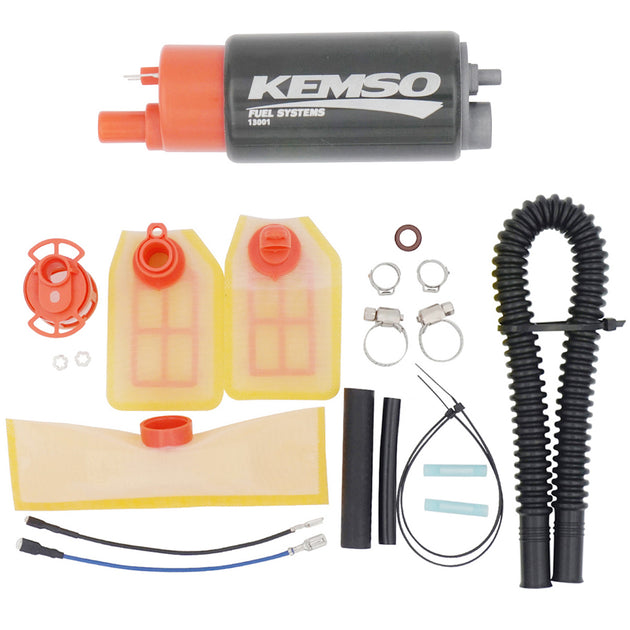 Voltage load monitoring provides crucial evidence. When using an oscilloscope to test the fuel pump circuit, the normal current should be stable at 5A-8A (for a 12V system), and the ripple coefficient should be less than 5%. If there is a current fluctuation of more than 15% or a momentary voltage drop of more than 2V (as required by the Volkswagen EA888 engine diagnostic protocol), it indicates that the impedance of the pump body motor is abnormal. The IHS Markit maintenance data of 2022 shows that the misjudgment rate of such electrical signal faults is as high as 24%. Therefore, it is necessary to cross-verify with pressure data. A typical case is that in the idle jitter repair of Audi Q7, after replacing the Fuel Pump, the standard deviation of the current dropped from 1.2A to 0.3A, and the speed fluctuation was reduced by 80%.
The oil compatibility test confirmed that when the proportion of ethanol gasoline is greater than 15%, the swelling rate of some pump body seals may reach 3%, resulting in an internal leakage rate of more than 200ml/min. Tests by the American Society for Testing and Materials (ASTM) show that poor-quality fuel shortens the lifespan of pump bodies from 10 years to 6 years and increases the probability of failure by 45%. Consumer reports indicate that Chevrolet Silverado using E85 fuel has a fuel pump flow rate decline rate as high as 0.03L per thousand miles after 50,000 miles of driving, directly related to 22% of idle complaint cases. After cleaning the fuel tank and replacing it with a compatible pump body, the recovery rate exceeds 90%.
The final verification should adopt closed-loop diagnosis: connect the diagnostic instrument to read the long-term fuel correction value (LTFT). If it persists above +10% and is accompanied by fluctuations of short-term correction (STFT) above ±8%, combined with the oil pressure test value < 35psi (General Motors standard), the pump body fault can be identified. According to statistics from Toyota Technical Institute, the accuracy rate of this method is 92%, and it can reduce maintenance costs by 60% compared with blind replacement of throttle valves and other solutions. A typical example is the maintenance case of the Lexus IS250. After replacing the Fuel Pump, the LTFT recovered from +18% to +3%, and the standard deviation of idle speed dropped from 45rpm to 8rpm.
Voltage load monitoring provides crucial evidence. When using an oscilloscope to test the fuel pump circuit, the normal current should be stable at 5A-8A (for a 12V system), and the ripple coefficient should be less than 5%. If there is a current fluctuation of more than 15% or a momentary voltage drop of more than 2V (as required by the Volkswagen EA888 engine diagnostic protocol), it indicates that the impedance of the pump body motor is abnormal. The IHS Markit maintenance data of 2022 shows that the misjudgment rate of such electrical signal faults is as high as 24%. Therefore, it is necessary to cross-verify with pressure data. A typical case is that in the idle jitter repair of Audi Q7, after replacing the Fuel Pump, the standard deviation of the current dropped from 1.2A to 0.3A, and the speed fluctuation was reduced by 80%.
The oil compatibility test confirmed that when the proportion of ethanol gasoline is greater than 15%, the swelling rate of some pump body seals may reach 3%, resulting in an internal leakage rate of more than 200ml/min. Tests by the American Society for Testing and Materials (ASTM) show that poor-quality fuel shortens the lifespan of pump bodies from 10 years to 6 years and increases the probability of failure by 45%. Consumer reports indicate that Chevrolet Silverado using E85 fuel has a fuel pump flow rate decline rate as high as 0.03L per thousand miles after 50,000 miles of driving, directly related to 22% of idle complaint cases. After cleaning the fuel tank and replacing it with a compatible pump body, the recovery rate exceeds 90%.
The final verification should adopt closed-loop diagnosis: connect the diagnostic instrument to read the long-term fuel correction value (LTFT). If it persists above +10% and is accompanied by fluctuations of short-term correction (STFT) above ±8%, combined with the oil pressure test value < 35psi (General Motors standard), the pump body fault can be identified. According to statistics from Toyota Technical Institute, the accuracy rate of this method is 92%, and it can reduce maintenance costs by 60% compared with blind replacement of throttle valves and other solutions. A typical example is the maintenance case of the Lexus IS250. After replacing the Fuel Pump, the LTFT recovered from +18% to +3%, and the standard deviation of idle speed dropped from 45rpm to 8rpm.
Voltage load monitoring provides crucial evidence. When using an oscilloscope to test the fuel pump circuit, the normal current should be stable at 5A-8A (for a 12V system), and the ripple coefficient should be less than 5%. If there is a current fluctuation of more than 15% or a momentary voltage drop of more than 2V (as required by the Volkswagen EA888 engine diagnostic protocol), it indicates that the impedance of the pump body motor is abnormal. The IHS Markit maintenance data of 2022 shows that the misjudgment rate of such electrical signal faults is as high as 24%. Therefore, it is necessary to cross-verify with pressure data. A typical case is that in the idle jitter repair of Audi Q7, after replacing the Fuel Pump, the standard deviation of the current dropped from 1.2A to 0.3A, and the speed fluctuation was reduced by 80%.
The oil compatibility test confirmed that when the proportion of ethanol gasoline is greater than 15%, the swelling rate of some pump body seals may reach 3%, resulting in an internal leakage rate of more than 200ml/min. Tests by the American Society for Testing and Materials (ASTM) show that poor-quality fuel shortens the lifespan of pump bodies from 10 years to 6 years and increases the probability of failure by 45%. Consumer reports indicate that Chevrolet Silverado using E85 fuel has a fuel pump flow rate decline rate as high as 0.03L per thousand miles after 50,000 miles of driving, directly related to 22% of idle complaint cases. After cleaning the fuel tank and replacing it with a compatible pump body, the recovery rate exceeds 90%.
The final verification should adopt closed-loop diagnosis: connect the diagnostic instrument to read the long-term fuel correction value (LTFT). If it persists above +10% and is accompanied by fluctuations of short-term correction (STFT) above ±8%, combined with the oil pressure test value < 35psi (General Motors standard), the pump body fault can be identified. According to statistics from Toyota Technical Institute, the accuracy rate of this method is 92%, and it can reduce maintenance costs by 60% compared with blind replacement of throttle valves and other solutions. A typical example is the maintenance case of the Lexus IS250. After replacing the Fuel Pump, the LTFT recovered from +18% to +3%, and the standard deviation of idle speed dropped from 45rpm to 8rpm.