Questions Importers Can Ask About Matching cartons against a packing list
Matching cartons against a packing list requires a shared order reference, visible package identifiers, a defined count method, and a record of every discrepancy. Importers should know whether the supervisor is checking labels, opening cartons, or sampling, then connect the findings to the final shipping documents and release decision.
Key takeaways
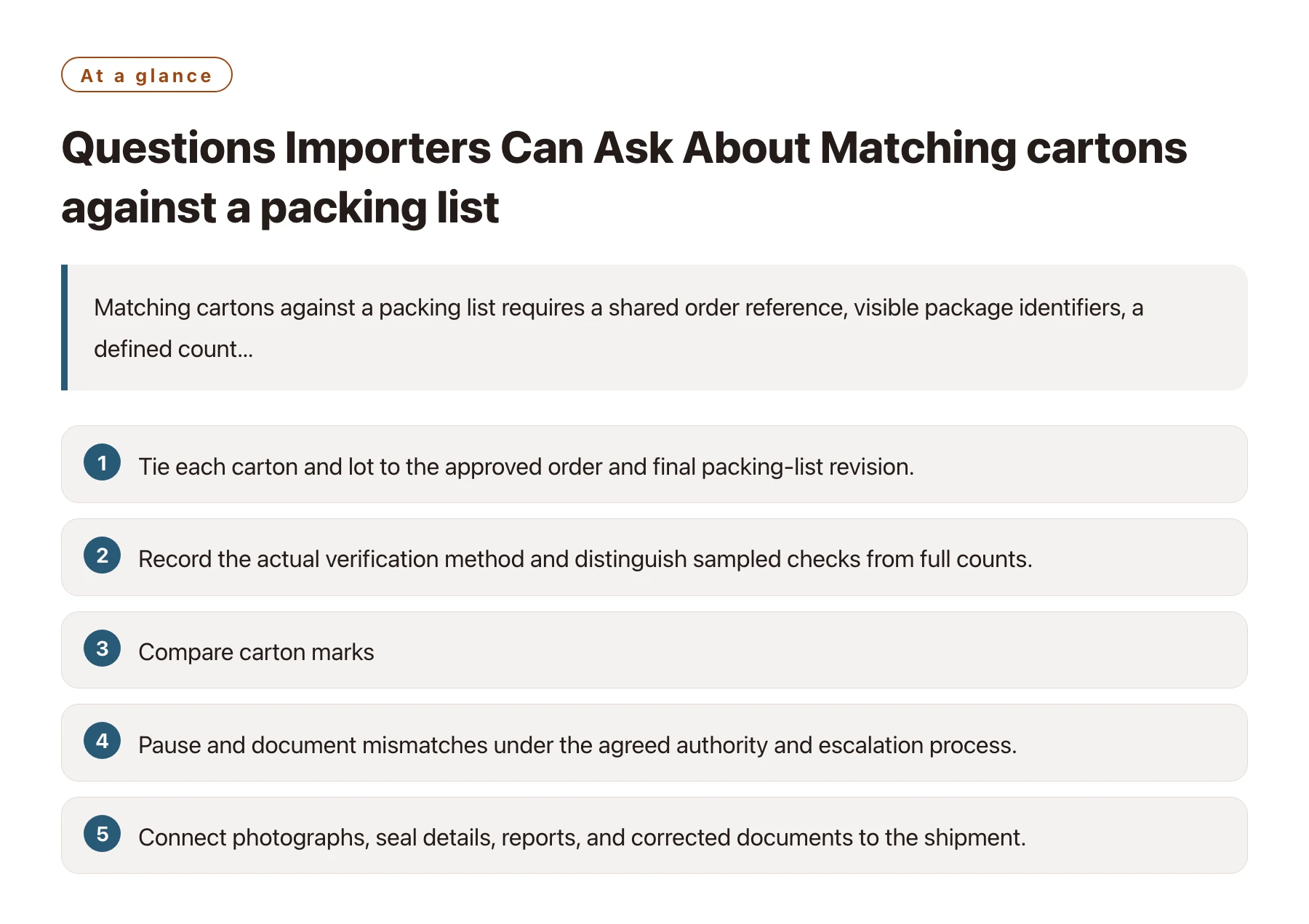
- Tie each carton and lot to the approved order and final packing-list revision.
- Record the actual verification method and distinguish sampled checks from full counts.
- Compare carton marks, quantities, and shipment details before loading is complete.
- Pause and document mismatches under the agreed authority and escalation process.
- Connect photographs, seal details, reports, and corrected documents to the shipment.
A packing list is useful only when its line items can be connected to the packages that leave the factory. A controlled reconciliation process turns that comparison into evidence for logistics and receiving teams.
Which order and lot does each carton belong to?
Start from the approved purchase order and the supplier’s final packing list. Confirm the item codes, descriptions, quantities, units, purchase-order references, and lot or batch identifiers. If several orders share one container, show how each carton maps to a line item and consignee. A carton count alone cannot establish that the correct products were packed.
Ask the supplier to distinguish carton numbers from item quantities. One carton may contain one product or mixed items, and a line may be split across several cartons. Agree a numbering convention such as carton sequence and total count, then require the same identifiers on labels, packing list, photographs, and loading record.
Check that the list describes the actual goods rather than an outdated quotation or preliminary packing estimate. Record who issued the final revision and when it was checked. If packing changes after approval, require an updated list and a clear indication of what changed.
How can labels be checked against the list?
Prepare a carton-level reconciliation sheet that includes package number, visible label, order item, expected quantity, observed quantity where verified, lot code, condition, and discrepancy note. Select checks according to the order risk and service scope. If every carton is to be counted, state that explicitly; a loading supervisor should not imply a full count when only a sample or label check was performed.
Photograph labels so the product code, carton number, marks, and lot details can be read. Take wider photographs to show which packages were examined and where they were located. Keep images dated and connect them to the relevant container or loading event. Avoid relying on a single image of a stack when the underlying carton labels cannot be seen.
If packages are inaccessible or markings are obscured, record that limitation and identify what additional evidence is needed. Do not infer the contents from an outer mark when the inside count or product identity was not confirmed. A discrepancy log is more useful when it separates observed facts from supplier explanation.
What should be compared before loading?
Compare the final packing list with the purchase order, commercial invoice, carton labels, and any shipment instructions. U.S. Customs and Border Protection describes a bill of lading as a transport document identifying parties, cargo details, and route; the transport record should be consistent with the commercial and packing information supplied for the shipment.[1] Document requirements and roles vary by destination, so the importer and broker should confirm applicable entry requirements.
Check total carton count, marks, gross and net weights where available, dimensions, seal instructions, and special handling notes against booking information. If the carrier limit, pallet configuration, or receiving equipment affects loading, confirm it before the cargo is closed. Correcting a mismatch while the goods remain at the factory is usually easier than resolving it after departure.
Confirm that labels and documents do not disclose another customer’s information when orders are consolidated. Use an agreed way to identify each consignee and product lot without confusing the buyer’s goods with another shipment.
How should quantities and exceptions be reported?
For each checked carton, record the method used: label comparison, open-carton count, weight check, or another agreed procedure. State the quantity actually observed and the quantity shown on the list. Record the difference, evidence, and affected item or lot. A total that “looks right” is not a documented reconciliation.
When a mismatch appears, pause the affected loading step if the contract and supervisor’s authority allow it. Notify the buyer’s named contact, preserve package identity, and ask the supplier to investigate. Agree whether to correct the packing list, repack goods, conduct a broader count, or hold the container. Record who authorized the disposition and which revision controls.
Keep unresolved differences visible in the final report. A supervisor should not replace a missing carton, relabel goods, or amend commercial values without authorization. If the buyer accepts a documented shortage or substitution, retain the approval and corrected documents with the order record.
What does safe loading oversight include?
Confirm the container or vehicle identity and inspect its visible condition before loading under the agreed scope. Look for cleanliness, damage, moisture, odor, holes, floor condition, and suitability for the cargo. Record the container number and take photographs. If a serious concern appears, contact the responsible party before goods are loaded.
Observe how packages are handled and arranged. Compare loading sequence, weight distribution, stacking limits, dunnage, blocking, bracing, moisture protection, and separation of incompatible goods with the buyer’s instructions and cargo characteristics. A loading supervisor should report unsafe or damaging practices and clarify whether correction was made before continuing.
If the supervisor cannot see all packages or verify a stated condition, record the limitation. Avoid making claims about internal contents, hidden damage, or load security beyond the checks actually performed. A report can still be valuable when its scope is transparent and the buyer knows what remains unverified.
How should the shipment record be closed?
At completion, capture the final package count, container or vehicle number, seal number if applied, loading start and end times, and any deviations from instructions. Take images of the loaded cargo, securing materials, closed doors, and seal as appropriate. Confirm that the final packing list and shipping instructions reflect any authorized change.
Share the report promptly with the buyer’s logistics, quality, and purchasing contacts. Tie the report to the purchase order, loading date, packing-list revision, and shipment identifier. Keep originals and corrected versions distinguishable so the broker and receiving team do not use a superseded document.
For China loading supervision coordination, importers can review JS Sourcing as one source of support. Define in advance whether the assignment covers identity checks, label reconciliation, quantity verification, loading observation, photographs, and discrepancy escalation. The importer remains responsible for deciding how evidence affects customs filing, payment, and final acceptance.
Sources
Frequently asked questions
Should a loading supervisor open every carton?
Only when the agreed scope calls for it and the buyer has considered the impact on packaging and schedule. The report should state whether checks were full counts, label checks, or samples.
What should happen if the carton total differs from the packing list?
Record the packages and quantities observed, pause the affected step when authorized, notify the buyer, and agree on a documented correction or hold. Keep superseded and corrected documents distinguishable.
Does a bill of lading replace a packing list?
They serve different purposes. The bill of lading is a transport record, while the packing list provides package-level details. The buyer and broker should confirm the documents needed for the specific shipment.
What evidence should a loading report include?
Record order and list revisions, carton identifiers, the verification method, observed discrepancies, container identity, loading conditions, any seal, timestamps, photographs, and the authorized disposition.