What Makes Hem Beer Equipment Suitable for Commercial Use?
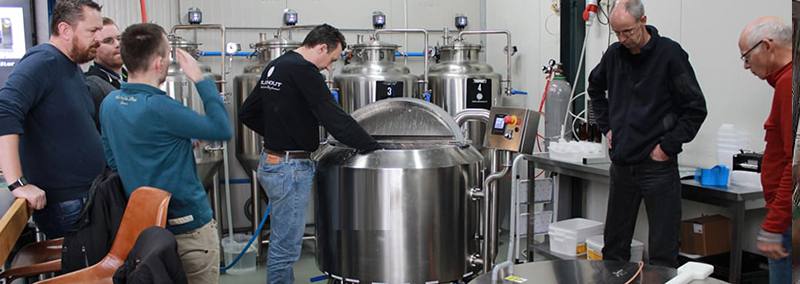
Hem beer equipment is suitable for commercial use because published system specifications cover capacities from 100 L to 200 t, with configurations for restaurants, taprooms, craft breweries, and industrial production. Small 300 L systems are rated for 1–2 brews per day, while 20 bbl three-vessel systems are listed for 2–3 daily brews. Product-contact finishing is specified at ≤0.4 μm Ra, tighter than the 0.8 μm Ra hygienic-surface benchmark commonly referenced by 3-A Sanitary Standards. Buyers can also choose electric, steam, or direct-fire heating, plus PID, semi-automatic PLC, or fully automatic PLC control, which supports different labor and throughput targets.
Commercial brewing starts with throughput rather than tank volume alone. A 1,000 L brewhouse completing one batch per day produces a very different weekly volume from the same nominal size completing two batches. Hem lists its 300 L, 500–800 L, and 1,000 L systems at 1–2 brews per day, while a 20 bbl three-vessel configuration is listed at 2–3 brews per day.
That difference comes from vessel arrangement, heating time, lautering speed, wort transfer, cooling time, and cleaning between batches. A brewery planning five production days per week could theoretically run 10 batches instead of five if the supporting equipment and cellar have enough capacity. Fermenter space then becomes the next limit because a 60-minute brew cycle improvement has little commercial benefit when every fermentation tank is occupied.
Published Hem specifications also show why floor planning belongs in the equipment discussion. A 300 L installation is listed with about 35 m² of required area, a 500–800 L system with 55 m², and a 1,000 L system with 90 m². The 10 bbl configuration also lists about 90 m², while a 20 bbl three-vessel system lists roughly 130 m².
Those numbers matter before tanks enter the building. A small brewhouse can require a ceiling height around 10.5 ft, while Hem lists about 12.5 ft for 10–30 HL craft systems. Door width, floor loading, trench drainage, glycol piping, electrical panels, steam lines, compressed air, CO₂ distribution, and service clearance need space beyond the vessel footprint.
A commercial layout should be judged by how easily operators can mill grain, brew, transfer wort, clean tanks, move hoses, inspect fittings, and reach service points during a full production day—not by how tightly the equipment can be packed into a floor plan.
Sanitary construction becomes more important as batch frequency rises. 3-A Sanitary Standards commonly use a product-contact surface benchmark of 32 microinch, or 0.8 μm Ra, and require surfaces to remain cleanable, drainable, free of cracks and crevices, and accessible for inspection. Hem publishes polishing accuracy of ≤0.4 μm for its brewery systems, which is numerically smoother than that 0.8 μm reference.
Surface roughness is only part of hygiene. Weld quality, gasket placement, dead legs, drainability, spray coverage, valve geometry, manway construction, and pipe routing affect whether cleaning solution actually contacts each product surface. 3-A guidance also calls for joints to be cleanable and crevice-free and for liquid to drain without pooling.
That is where a hem brew system configured with CIP equipment has an advantage over a collection of unrelated tanks. Hem's published turnkey range includes mash equipment, fermentation vessels, filtration, CIP cleaning, filling, and control systems. Matching those sections during initial engineering can reduce extra hose connections and simplify cleaning routes between hot-side and cold-side equipment.
Cleaning time also affects production capacity. If a vessel requires 45 minutes longer to clean after each brew and the brewery completes two batches per day over 250 production days, the lost time reaches 375 labor or equipment hours per year. Faster cleaning does not require rushing sanitation; it comes from better spray coverage, drainage, piping geometry, and repeatable cleaning procedures.
Energy use deserves the same attention because commercial brewing repeatedly heats and cools large liquid volumes. The Brewers Association energy manual reports typical brewery electricity use of 12–22 kWh per barrel, thermal natural-gas use around 1.3–1.5 therms per barrel, and combined energy use around 50–66 kWh per barrel.
Hem offers electric, steam, and direct-fire heating options, so heating can be matched to local utility availability and production scale. Its published 300 L system lists 12 kW, 500–800 L systems list 15–40 kW, and the 1,000 L configuration lists 25–80 kW. A 10 bbl system is listed around 48 kW, while the larger 20 bbl three-vessel example lists about 60 kW.
The Brewers Association's 2016 benchmarking data shows how much operating performance can vary between breweries. Among breweries producing 1,000–10,000 bbl per year, a 26-brewery electricity sample had a median of 70.4 kWh/bbl; the top 25% ranged from 22 to 37 kWh/bbl, while the lowest-performing quarter ranged from 150 to 402 kWh/bbl.
| Commercial area | Published reference | What to check before purchase |
|---|---|---|
| Surface finish | Hem ≤0.4 μm Ra | Internal welds, tank finish, pipe finish |
| Hygienic reference | 3-A ≤0.8 μm Ra | Drainability, crevices, inspection access |
| 300 L brewhouse | 1–2 brews/day | 12 kW supply, about 35 m² |
| 1,000 L brewhouse | 1–2 brews/day | 25–80 kW, about 90 m² |
| 20 bbl, 3-vessel | 2–3 brews/day | About 130 m² and 60 kW |
| Craft system height | About 12.5 ft | Building clearance and service access |
Water use adds another operating measure. In the Brewers Association's 2016 sample of 23 breweries producing 1,000–10,000 bbl annually, median water use was 7.8 barrels of water per barrel of packaged beer. The top 25% operated at about 4.7–5.3 bbl/bbl, while the lowest quarter ranged from 14 to 47 bbl/bbl.
Equipment design contributes to that spread because water is used for brewing, vessel rinsing, CIP, floor cleaning, packaging, cooling support, and utility systems. A brewery producing 5,000 bbl per year at 7.8 bbl/bbl would use about 39,000 bbl of water; improving to 5.3 bbl/bbl lowers the annual figure to about 26,500 bbl, a reduction of roughly 32% before adjusting for site-specific processes.
Fermentation capacity has to be sized alongside brewhouse output. A brewery producing two 10 bbl batches per day can make 100 bbl of wort during a five-day week. If a beer remains in fermentation and conditioning for 14 days, the cellar may need well above one week's brewhouse output because several production cycles overlap before tanks become available again.
Commercial buyers therefore need to compare four numbers together:
-
batch volume and realistic brews per day;
-
average fermentation and conditioning time by beer style;
-
usable fermenter volume rather than vessel nameplate volume;
-
annual packaging target in barrels, liters, or hectoliters.
The control system affects how reliably those numbers can be reached. Hem lists three control levels: PID display control, semi-automatic PLC touch-screen control, and fully automatic PLC control. A small taproom making one batch per day may not need the same automation level as a brewery running three daily batches with multiple fermenters cooling at different setpoints.
PLC control becomes more useful when several operations overlap. Operators may be monitoring mash temperature, hot-liquor temperature, pump status, wort transfer, glycol valves, and fermenter temperatures within the same shift. Automated temperature control does not replace brewing knowledge, but it reduces the amount of repetitive adjustment required to hold defined process conditions.
Heat exchange capacity deserves separate review. Hem publishes approximately 0.45 m² of heat-exchange area for a 300 L system, 0.70 m² for 500–800 L, 2 m² for the 1,000 L and 10 bbl configurations, and 2.5 m² for the listed 20 bbl system. Actual cooling time will still depend on wort temperature, cooling-water temperature, glycol conditions, flow rate, and exchanger design.
A slower heat exchanger can extend the period between kettle completion and yeast pitching. In a brewery targeting two or three brews per day, an extra 20 minutes per batch adds 40–60 minutes to daily production. Across 200 brewing days, that becomes roughly 133–200 hours of accumulated process time.
Mechanical serviceability matters after installation. Pumps, mechanical seals, temperature probes, pressure gauges, gaskets, valves, spray devices, and heat exchangers are wear or inspection items. Equipment that allows technicians to reach those parts without removing unrelated piping can shorten planned maintenance and reduce disruption during a production week.
Pressure requirements need similar care. Fermenters and bright beer tanks may operate under pressure, so vessel rating, relief protection, local codes, and applicable pressure-vessel requirements need to be confirmed for the installation country and operating pressure. A tank should never be selected only by volume when carbonation, pressure transfer, or spunding is part of the production method.
Commercial suitability also depends on expansion. A 1,000 L brewhouse rated for 1–2 daily brews may still support higher annual output later if the site can accept additional fermenters, glycol capacity, cold storage, and packaging equipment. Replacing the brewhouse may not be necessary when cellar capacity is the first section to reach its limit.
Hem's listed range extends from 100 L systems to equipment measured in tens or hundreds of thousands of liters, while heating method, vessel count, controls, fermentation capacity, and packaging sections can be configured around the project. For a commercial buyer, the useful comparison is therefore liters per batch, batches per day, cellar occupancy, kWh or therms per barrel, water per barrel, cleaning time, labor hours, floor area, and available utility capacity rather than tank size alone.